अतिथि देवो भवः
Seven thousand kilometres of coast, the highest mountains on earth, rivers that civilisations were born beside, and a different meal every hundred miles. Scroll through the peaks, the waters, the temples and the flavours of a subcontinent.
Namaste नमस्ते নমস্কার
The subcontinent
A country that behaves like a continent.
India runs from glaciers at 7,800 metres to coral atolls at sea level, from a rainforest that receives eleven metres of rain a year to a salt desert so flat it reflects the moon. Inside that space live 1.4 billion people speaking 22 official languages and cooking, very roughly, an infinite number of dishes.
01 — Destinations
The places people cross oceans to see.
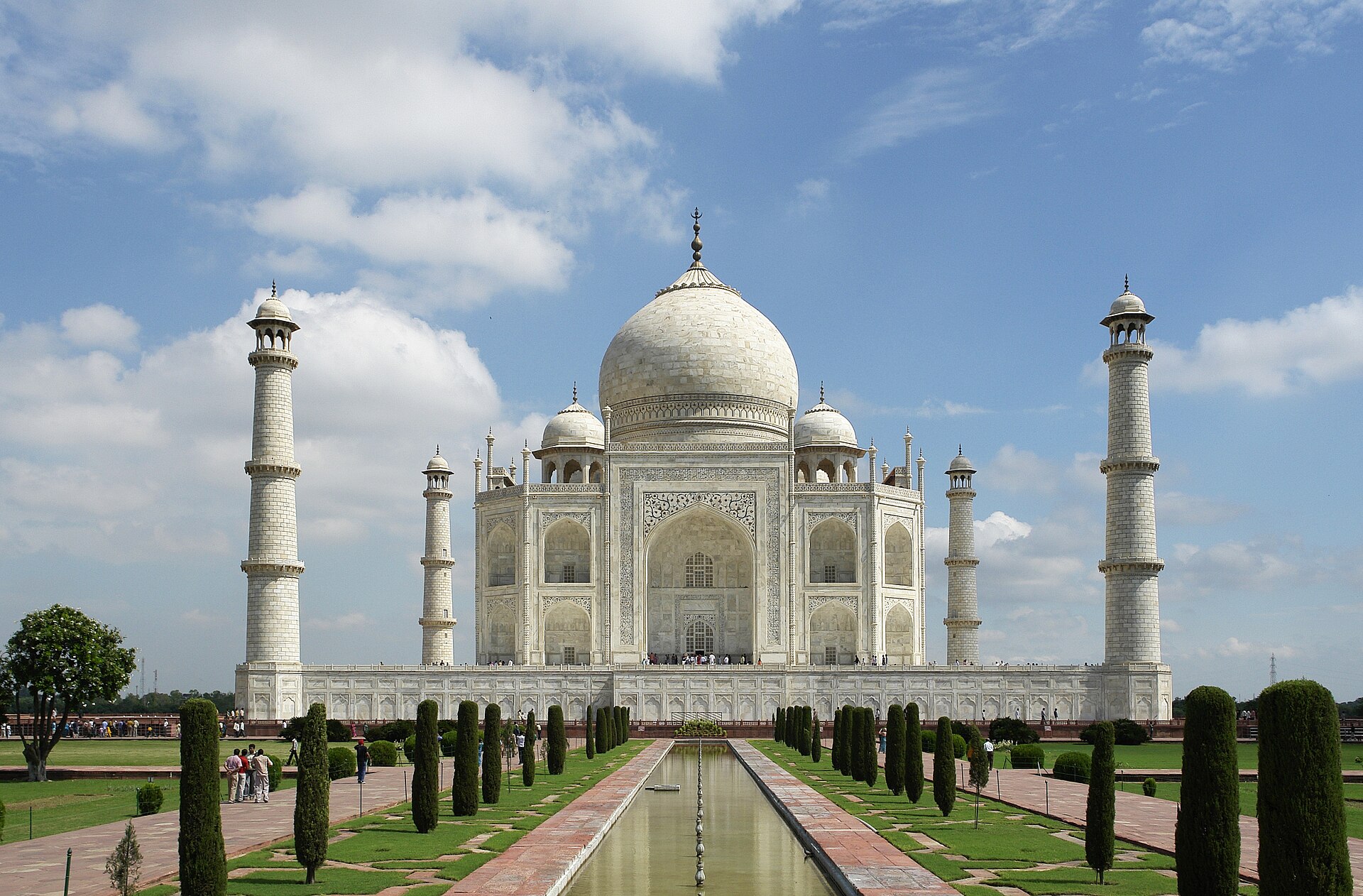
Marble tombs and salt deserts, ruined empires and living lakes. Filter by region — every card explains what actually makes the place famous.
02 — Mountains
Walls of rock that make the weather.
The Himalaya block the cold air of Central Asia and trap the monsoon against India's north — which is the only reason the plains below are fertile. Older still are the Aravalli in the west and the Western Ghats along the coast, both hundreds of millions of years senior to the Himalaya.

The Himalaya
2,400 km of collision zone, still rising about 5 mm a year as the Indian plate pushes north into Asia. Nine of the world's fourteen 8,000-metre peaks stand in this range.
03 — Rivers
Water that is also a goddess.
In India a river is rarely just a river. The Ganga is addressed as a mother, the Narmada is walked end-to-end as a pilgrimage, and the Indus gave the country the name the rest of the world uses. Together they irrigate the most densely farmed land on earth.
04 — Temples
Stone cut into a kind of mathematics.
A Chola temple raised an 80-tonne granite capstone 66 metres into the air in 1010 CE. A temple at Ellora was carved downward out of a single cliff, removing 200,000 tonnes of rock with no possibility of correcting a mistake. Drag the row sideways.
05 — Culture & festivals
A calendar with almost no empty days.
Colour thrown in the street in spring, a hundred million people bathing in one river in winter, a dance form that takes eight years to learn and six hours to apply the make-up for. Hover any tile for the story.
06 — Food
There is no such thing as Indian food.
There are a few hundred regional cuisines that share a spice cabinet. The north cooks with wheat, dairy and slow heat; the south with rice, coconut and fermentation; the coast with fish and tamarind; the west with sugar, chilli and speed. Scroll on — this section moves sideways.
07 — National symbols
The living things a country chose.
A tiger that replaced a lion, a bird whose train is not a tail, a dolphin that is blind, and a tree that outgrew its own trunk. These belong to the whole country — the state listed with each is where it is most at home, not where it began.
08 — Why each place is famous
Tap the map. Every dot has a reason.
Twenty landmarks placed at their real coordinates. Select one to see what it is known for, what to eat there, and when to go.
Stylised outline. Landmarks are plotted at their real latitude and longitude, so their positions relative to one another are accurate; the coastline is simplified and the boundary is not an authoritative depiction.